Photo Galleries:
Note
A power point presentation titled Return of Vishnu - (55mb ppt) was presented at the Indira Gandhi National Centre for the Arts (IGNCA), New Delhi, India - July 13, 2009
Slowly an image began to form in my mind’s eye of what the city of Varanasi, India might appear to look and feel like before I set my eyes and feet upon it. The impressions I had of Varanasi were so many that combining them to fit into a meaningful collage of stories and myths was very difficult. The myths of Varanasi were so old that the word ancient was not even close in describing this ancient of ancient cities. Varanasi has existed next to the Ganges River for an eternity reflecting the same timelessness as the stars in heaven. All these images of Varanasi began to form a picture in my mind’s eye by sometimes coming in dreams, sometimes when reflecting on ancient India and sometimes with thoughts of Shiva and Parvarti who had established their home in this scared of all places. And in the not too distant future, 108 days of this writing, an asura would be disguised as a deva sitting next to the gods quietly awaiting the amrita to be poured from the golden pot (kumba) that would allow the gods to live an immortal life. However, the asura would be caught in his disguise pretending to be a god because standing next to the gods Surya and Chandra was Vishnu disguised as the beautiful Mohini who would see this intrusion and immediately behead the asura with his sudarsan cakra. The amrita, the sacred liquid churned from the milky ocean, giving immortality to all who drank it, was able to reach the asura’s throat only making his head become immortal. He would wait eternally for the chance to devour the sun during a solar eclipse for his revenge of being denied immortality. His head would be known as Rahu the dragon eater, and the trunk of his body forming the dragon’s tail would be known as Ketu. These two parts of the asura’s body would eventually form the north and south nodes of the moon forming an axis of eternal tension between what is desired and what is remembered.
This then is a brief introduction of when the dragon head of Rahu will appear once again to consume the sun and this time plunge the city of lights,Varanasi, into darkness. But Shiva will appear floating high in the heavens and bestow boons on all his devotees doing their oblations in the Ganges River. Shiva will rise in the heavens with his brilliant pillar of light (sthanu) penetrating the three worlds and forever reminding his devotees he will always be with them and never forsake them in times of darkness and despair.
This mythical representation of a full solar eclipse, which will take place in 108 days, and if coincidence upon coincidence isn’t enough to remind one of the powers of Shiva, there are 108 names for Shiva so each day before the full solar eclipse one of Shiva’s names will be recited as a gesture to his honored place in Varanasi; his first as of this writing being, Aashutosh, (The one who fulfills wishes instantly). It is my wish to be in Varansi to receive a boon from Shiva. Writing about some place without actually seeing it, hearing chants or being filled with the smells coming from countless cremation pyres, or more varieties of incense thought possible helping to answer all the uncertainties of Varanasi before its presence was seared upon the deepest recesses of my mind so that no matter how hard I would try Varanasi could never be erased from my memory unless the very universe itself were to vanish, never to breath thoughts or see suspended starlight in the vastness of eternity, seems like an impossible task.
For all the pundits who have provided their insights for the reasons Varanasi remains the preferred place to release a human soul on this planet there has to be some explanation for this to be so. As a pilgrim who has already climbed the sacred mountain of Lingaparvata in Southern Laos in 2006 to honor Lord Shiva, a trip to Varanasi fulfills a quest to be in the presence of a celestial awakening the likes of which will not happen again in this century. And if starlight and star lore are married forever in a twilight language known only by a few shamans whose dismembered bodies were able to fly away to those distant stars to hear that language of the gods then that language will be heard again when the most auspicious of relationships takes place in the heavens and on earth over the sacred city of Varanasi on July 22, 2009.
So what might this language of the gods be trying to talk about when the Lord of the Moon would greet the morning sun at Somnath? And what were all the holy men across India, Bhutan, Nepal and Tibet about to receive from the most auspicious sign over their land since the beginning of time? What instinctual forces were born by the great mother to give humanity the curiosity to look at the heavens in the dark of night and wonder what those twinkling lights were trying to say? Placing one’s self into a time long past before sounds were ever uttered or marks ever drawn by our distant ancestors is of course extending our imagination to enter a fantasy like world because we of today have encumbered ourselves within a matrix of meaning of the origins of the starry heaven which has been imposed on civilization for well over 2000 years. To be able to return to the time of the origins of consciousness, a time before concept of self interrupted the divine will of the heavens when man and god were of one mind is not possible. Yet scattered all over the earth are reminders of humankind’s early attempts to record the heavens either on bones, cave walls or stone temples sequestered in jungles or nestled on mountain tops demonstrating that our ancestors had a direct relationship with the stars as well a sense of their origins. This star sensibility has not changed nor has the desire to peer into the heavens over the millennia which is evident in the current day and age with space ships repairing telescopes orbiting the planet. Certainly the stars still captivate the attention of our species and there is a very good reason for doing so; they bring us closer to the divine beginnings and source or our beingness.
However, modern civilization began to utilize the knowledge of the stars through its own interpretations rather than attributing their origins to the heavenly host and mortal cognition replaced immortal cognition. But not all of mankind ignored what the stars had to say because the stories told by our ancestors became embedded in myths have now have been deciphered and the grandest of epics, the of creation of the universe, has come to life by the ability to decipher the many languages our ancestors have left behind to describe what they felt and saw. From petroglyphs to hieroglyphs every culture has left behind a trace and in some cases entire structures reminding the world of the great civilizations which once reigned upon this earth. But even with all the discoveries of these ancient civilizations, which have been transported in pieces and displayed around the world, not all of the discoverers and historians agree with the intention or meaning of the cosmologies these civilizations may have entertained. With such uncertainty as to the wisdom of our ancestors, modern man, using a mind set born out of reason, has promoted a history of our ancestors which has become accepted and built upon forever sealing the truth of the original message many believe was left for us of today to understand. This division of a history stretching far into the past and the world we live into today has been best expressed by the French philosopher Mircea Eliade with his insightful contribution to the dilemma facing us today titled The Scared and the Profane. What constitutes sacredness and what constitutes the profane? For many there is no understanding of even this distinction because the motivating feelings which have been discovered to be the real source of adapting to being born on this earth is to survive by finding a way to live by tendering all our basic needs. Birth has become a dependency on a financial arrangement with the world at the exclusion of any activity which does not keep that dependency always a necessary endeavor. But the real manna comes from heaven and even because it’s necessary to be on earth to receive the power of the elemental forces of nature we are left with one of our ancestors famous sayings, “Man does not live by bread alone” (Deuteronomy 8: 3).
The controversy will continue as to what our ancestors were trying to tell us, but one message they left behind, which is well known and agreed upon, is that the sun changes its position against the background of stars and through the study of the calendrics of the Mayan civilization the date of 2012CE has been deciphered leading to a worldwide awareness of the precession of the equinoxes and the arrival of the Aquarian age. That awareness alone has unleashed the most concerted effort to analyze the astronomical awareness which our ancestors understood and the meaning they attributed to their peering into the heavens.
One of the most dramatic and exciting celestial phenomenon which has produced more than a divine relationship to the heavens through stories and legends is the full solar eclipse. And in as much as the Indian cosmology relies and depends on its understanding of the heavens a full solar eclipse taking place over its most sacred of cities is anticipated with a rare sense of auspiciousness. Planning on seeing this solar eclipse and deciding to be in its presence became the motivating desire to witness how heaven and earth are connected by sacred ritual.
The day I entered Varanasi, India was unlike anything I had expected. Its size was incomprehensible with an ordered chaos unlike anything I’d ever seen. Trying to imagine how Muslim emperors of the past had entered this city only to destroy its temples and then have the Hindus assert themselves time and time again with their own stamp of reality is testimony to how the spiritual forces have crafted this city with stone set upon stone and within each corner of the myriad of buildings contains a temple also made of stone with long dark corridors disappearing around those corners into a dungeon like eternity of dark and winding lanes. Gargoyles peering from high atop temple spires and stone sculpted bulls behind iron posts and railings surrounding small court yards give the illusion of a petrified jungle but with real monkeys and buffalos acting out a drama in an ornate world of timeless imagery.
It would be a folly to think I could add a dimension of expression that would in some way characterize this labyrinth of stone walk ways each disappearing into the most remote parts of human history. With bodies of the colorfully decorated deceased carried on bamboo stretchers by six or more runners along side buffalos that were charging down lanes to reach the Ganges for their afternoon baths in lanes barely big enough for them to walk is not an easy picture to paint. I suppose if I had to live in one of those dark infinite shadowy spaces I would know something of the history encased under all those stones. The golden Vishwanath temple sat amongst all these winding lanes like shards of luminous golden light piercing the noon day sky where upon I found myself sitting at a table in front of three armed police asking me if I were a Hindu. For on the wall directly out side the inner sanctum to the entrance of this golden temple is a white marble plaque clearly stating that no gentleman who is not a Hindu shall enter this holy place. My reply was that I was a devotee of Shiva who is loved by all Hindus. After signing my name in a register the size of the table itself I was searched to see if I carried anything which may bring harm to this holy of holies.
Fully prepared to pay my respects flowers and goat milk filled my arms and a Brahmin priest whisked me onto the brilliant while floors that surrounded the sacred temple housing the lingam of Shiva. The temple floors were gleaming white marble constantly being washed to remove the dirt from the thousands of feet streaming into this temple at a rate making a maddening crowd look tame by comparison. I was caught in an effulgent state of euphoria accented by impenetrable incense and devotional hymns and chants coming from every conceivable direction. Then slowly a pair of old Brahmin hands came out of a white robe and grabbed my body and pushed me into the leaning devotees waiting for a chance to reach over the silver protective railing and touch the top of the holy lingam of the Lord of the Universe sitting in a pool of milk and placed flowers, leaves and goat milk on top while all the devotees repeatedly chanted the holy mantras. For an instance I thought I may just fall into this small sea of flowers and white milk as others were pressing on my back and reaching over my head, but if it were not for once again being grabbed by the neck and pulled out of an endless mantra of “Om Namaya Shivya” I would of surely been lost in the floral mountain rising before me. Dense spirituality smothering all the senses to the point of only recognizing one reality; being lost in a forest of lingams hidden under a canopy of stone. If it were not for the Brahmin who escorted me into this inner sanctum I think I would have magically slipped between the stones only to become a permanent part of Varanasi. So completely overwhelming was this experience that to have been able to extricate myself from it felt more like escaping the grips of an eternity of souls all somehow encapsulating my own soul to be ever part of that oneness the temple was dedicated to.
Again, any description I could offer of this holy temple is a narrow and bleak attempt at a formal expression that could describe a space so full of worshipping Hindus. There is no distinction between any one because Shiva’s presence has completely driven all semblances of individuality into another time and space where what is left is sheer devotional potency expressed by thousands of mantras until the earth itself vibrates to its rhythm creating perpetual mini water falls coming from the hoses spraying water on the temple slabs of white marble eternally and forever while the devotees live out every pronouncement ever made by the wisest of sages.
What else can be said about such a place that is on this earth? Where else does the repetition, the forever pouring of milk on Shiva’s lingam not stop? As long as India has its people Shiva lingams will be blessed by all the Hindus of India who know full well this is what they must do to receive a blessing and a boon for a pure life in the eternal realm of the gods. Mythology need not be studied for whatever is said in the countless myths about Hindu gods has codified itself into perpetual human movement in the direction of the afterlife. The burning of bodies one after the other with hundreds of wood carriers fueling the fires from wood gathered from the distant northern forests ensures that the souls of India will be received by the gods in heaven. With smoke from the burning pyres penetrating my eyes I escaped into a small Shiva shrine over looking the Ganges that was dark with a black linga in the middle of the floor and darting eyes from a veiled woman in a painting who was looking out the window onto the Ganges. There are no words that can give these spaces their proper description because they are ethereal and only appear to be real when in fact they are all shapeless forms born out of pre-history that make themselves appear as if one were a spectator but in truth they were as much a part of the eternal as the smells and shadows being portrayed on the canvas of reality.
And even though modernity can be seen it’s as if it’s only a temporary experience that will pass but the eternal presence of the gods of India will prevail as they have again'st Muslim invasions and British aristocracy imposing its crown on a land where crowns were invented. There are no comparisons to be made. Its true Varanasi is the center of our world and whatever ego or national identity may be brought to its ghats is dissolved before any realization of loss of identity is realized.
And then that inevitable morning arrived when the dance of the heavenly bodies was supposed to appear over Varanasi. A solemn quiet filled every part of the city as if something momentous was going to erupt. And like some sort of wizard’s magic wand a sea of colorful saris and praying saddus began to appear by the thousands and trickle down the stone stairs of the ghats into the Ganges in numbers quite impossible to describe. A flowing rainbow of human forms hovering under a cloud filled early morning sky as the sun began to cast its tell tale orange glow in between the clouds with hopes and anticipation that the dreams and wishes to see gods creation appear was enough drama to excite the most timid of souls. It was a contest of the forces of nature with clouds and the sunrise reaching that appointed hour when the Lord of the Moon and the Lord of the Sun were to cross paths and reveal to the city of the light an ancient truth buried for thousands of years in all these stones making a most unique façade facing the eastern horizon. The clouds appeared and seemed to say they were the ones to be on stage and hide the play which everyone came to see and applaud. But the Lord of the Wind was also a player that morning and as much as the weight of the darkening clouds made their presence felt they begrudgingly began to move revealing the solar lord in all his glorious form radiating onto the Ganges and giving a golden glow to everything it touched. At that point the unexpected was about to occur and the beginning of the solar eclipse surprised all possible imaginings as the moon began to enter the stage and dance on the sun. Rahu was alive and well and began to devour the golden orb. The swelling of people began to reach proportions that seemed inconceivable and an ecstatic dancing of thousands began to take place. People chanting, praying, bathing, meditating, counting masala beads, bowing before the Lord all in one crescendo of human affectations took place as the entire landscape turned to blue black and the full shadow of the sun covered the earth and an upwelling of voices cried out and birds flew in every direction with the goats crying in bewilderment and there before everyone’s eyes was the most auspicious of all heavenly events directly over the city of light.
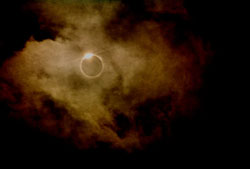
It was the most perfect alignment of the three heavenly bodies with the sun appearing as a radiating ring of twinkling fires behind the moon. And there it stayed for a very long time until the movement began again and an explosive light from the sun popped out into the morning sky and a thunderous roar from the millions of Hindus filled the Ganges sacred ghats. It was so dramatic just from the slow darkening of the river and ghats that when the solar eclipse was full an indescribable pause in every activity took place as Lord Surya was covered leaving behind in the dark morning sky a ring of shimmering fiery like beads encircling the rim of the sun. It was the longest mysterious animation of light that would be seen from a solar eclipse in this century and its presence was captivating and hypnotizing while one watched such a wondrous sight.
A ring of fire was suspended in the morning sky and looking at it was a mystifying experience as if more than just an eclipse was being beholden but a special kind of natural phenomenon that could bring about irrevocable changes in its human viewers as well as the land upon which its rays fell. This was the time when that dark blue gray umbrella was held in place by the heavenly bodies dancing in an ancient rhythm bringing about the elements of transformation in human destinies. Those three minutes were an eternity and all the messages from the ancient past were being delivered with each bead of fire that could clearly be seen suspended before everyone’s eyes. And even though time stood still there was an inner knowing that this was not going to last and all the secrets that were being unveiled were washing over all the devotees who came that morning to the edge of the Ganges River. It was a school or sorts and an entire education could be had if only all the secrets could be deciphered. Time was running out and as prayers were being offered and chants were being made Surya was about to release himself from the jaws of Rahu and return with the most explosive dazzling ray of light I have ever seen. It was so bright I had to turn my head and with my hand tightly holding the shutter extension to my camera I pushed the cord to trip the shutter and that photo is what is on the mast head of this paper. This was the diamond ring, that mystical moment when earth receives its new message from the Lord who is the messenger for all time. It is so apparent when it is seen and when next all the stories come to mind of the related myths the real event is the source with multitudes being affected on all levels. From this eclipse will pour forth the next stage of human evolution and whatever must be removed that is not working will be removed and the true harmony of nature will be instilled in the minds and hearts of the people on this earth.
That ring of mystical sunlight kept on delivering the greatest dispensation for our race as humans. And even though it has been recorded flawlessly by technology what can not be measured and recorded are the new rules of engagement to enter the next age. It is here our minds have to open to receive not only the suns rays (myukta), but the message in each of those rays. Witnessing the ancient sun discs dedicated to Surya buried in small homes and inside sequestered temples, Kashi has once again been energized to radiate a renewed energy which no nation or belief system can ever take away. This event eternally gave Kashi a preeminent position as Avimukta; the city of light. Here is where the solar eclipse revealed itself in a perfect synchronous dance of Shiva in the heavens allowing all the gods to have their time on the heavenly stage to enact their message. It was the grandest stage set ever devised by the gods with Kashi as its backdrop and all the extras filled the seats both on the steps of the ghats and on every grain of sand while the performance was so spectacularly executed in the heavens.
Kashi has been vilified and renewed as never before and at a time when the world has become more used to human carnage than spiritual events such as the one that has taken place in Kashi. In kashi the souls of all those humans who experienced the full solar eclipse were given an inexhaustible amount of spiritual awareness that will be talked about and eventually turned into myth so that generations far into the future will have a memory of this heavenly event.
Kurukshetra Kund
The perfect solar eclipse, also known as the Holy Solar Eclipse was if by some uncanny magic able to bring forth the forgotten stories and memories of all the gods who came to life at the Kurukshetra Kund. And once where only a few children were playing while the kund lie dormant under a sea of algae all of a sudden changed and became a crystal clear pool with the sacred pillar in the center of the kund pointing to the heavens and thousands of devotees came and dipped into the kund. I too joined them to honor the memory of the eclipse over Kurukshetra during the Barata war.
Before the day of the eclipse the Kurukshetra Kund looked abandoned and forgotten with algae radiating a sea of luminous lime green. The holy waters were completely covered with only the sacred pillar in its center breaking through the sea of green reaching for the blue sky. It was very disconcerting to walk around the kund knowing it was built in memory of the Kurukshetra war between the tribal families of ancient India forever memorialized in the epic poem of the Mahabarata. It was during this ancient battle, the battle of all battles which took place on Earth, when a full solar eclipse took place foretelling the outcome of this holiest of wars. So, in many ways the Kurukshetra Kund is the sanctum sanctorum for all Hindus for it is told that a dip in the Kurukshetra Kund would remove all sins and grant a place in the heavens with the gods during a full solar eclipse. But on this day the kund looked abandoned and forgotten and the Shiva temple was slowly showing its years with the outer perimeter walls totally crumbling. However, a smaller shrine housing the sacred linga on the opposite side of the kund was still used for worship.
I was told by those in charge of the sacred temples in Varanasi that letters had been sent to higher government officials to clean the kund, but on the day I arrived, four days before the full solar eclipse, all I could see was a vast sea of lime green algae. I really could not imagine that this apparent neglect of a holy tirtha could be forgotten because I knew that in the Haryana distinct of India, where the legendary tirtha of the Kurukshetra Kund mentioned in the Marhabarata existed, would receive millions of pilgrims who were preparing to dip into the kund during the solar eclipse and absolve all prior sins. Surely Varanasi knew of this sacred time and would see to it that their kund was cleaned for this most auspicious event.
The following day I returned to the kund I was astonished to find people with large wicker baskets taking the algae off the surface of the water. Sunlight reflected all over the patches of clear water and life had been awakened as if by some deep cultural switch that was turned on in peoples psyches at a particular time. The arrival of the solar eclipse was that ancient switch and again the memories of the past were becoming rekindled in the minds of the people in Varanasi.
On the next day the kund was completely cleared of algae and bamboo poles were placed around the kund so when taking a holy dip one would stay only on the steps waist high when descending into the kund. To clean and purify the water natural soda was thrown into the water gathered from breaking and smashing hundreds of natural soda rocks until they became small enough to dissolve quickly in the water. The kund was definitely going to be used and I realized that not only had I come to see the full solar eclipse but I was also going to dip into the sacred kund; an event that would not take place again for over one hundred years. Combining the two events enabled me to realize that I had put myself in a place where heaven and earth were going to be fully synchronized. To have a full solar eclipse occur directly over Varanasi along with a dip in the Kurukshetra Kund was a once in a life time event and an event I had to know about well ahead of time in order to plan on how best to go to Varanasi, India to witness and participate in this solar eclipse. On the day of the solar eclipse the Kurukshetra Kund was full of every conceivable color from the thousands of saris reflecting a multitude of rainbow variations in the ripples on the surface of the clear water of the kund creating some sort of gigantic water kaleidoscope.
From a once covered algae kund to a populated kund with clear waters and a thousand colors was the most inconceivable transformation imaginaginable. It was at this color extravagant moment that I walked down the stone steps and dipped into the kund as if it were the most natural thing to do. I became part of a ritual that was so old it would be impossible to say how old it really was. The entire Varanasi community became consecrated in one instance as the solar eclipse magically brought to life an ancient ritual that had been known and repeated time immemorial.
To even think of what may be on any one of the minds of these worshippers would be insignificant. The animated kund became the function it had always been constructed for. The cosmic pillar in the center of the kund, symbolizing the axis connecting heaven and earth, with ripples of color swirling around it as if a mini universe was being formed before my eyes with waves of Hindus perpetually dipping and praying transformed this totally stagnant pool into a vibrant world of color and sanctity. And with all those colors swirling before my eyes I could readily see the cosmology of the Lord of the Universe coming to life. It didn’t take any figuring out that a new universe was being created because the way in which people entered the water was proof enough that this kund was suspended high above Varanasi. As a result of knowing of this celestial event for well over a year and a half a great deal of research and preparation was initiated to learn of other synchronicities that may be going on at the same time as the eclipse. With the use of astronomy software, and the study of ancient sun temples within Varanasi it seemed as if this eclipse would carry overtones of more than a spectacular eclipse but also a time for renewed rituals to be reenacted around the ancient sun temples of which there were so many. The sun is worshiped daily on the ghats at Varanasi and even though the sun god Surya is not as visibly worshiped as is Shiva, Surya nevertheless has special shrines dedicated to him throughout Kashi. I took it upon myself, with the assistance of Dr. Rana Singh (Singh 2009), to visit these ancient sun temples during my stay in Varanasi which are not easy to find as they are hidden in the many alley like lanes that run through the ancient city to the furthest eastern end of all the ghats where the Adi Keshava Temple, Raj ghat stands solemnly facing the river Ganges.
On this auspicious day the gods were going to speak over Varanasi and in the early morning a silent mass of people slowly began to fill the steps of the ghats or wade into the Ganges. People began to appear as if by some magical summons to come to the Ganges, but it was more than just people for in many ways it was a scene of an enormous flowing of humanity coming from every conceivable direction along with water buffalos, young and old as the living were slowly pushing on the backs of each other to assure a place on the Ganges to receive the holy dispensations from the gods. To witness how so many thousands of people could place themselves in a perfectly crafted geometric watery pool complete with a pillar in the center surrounded by symmetrical steps causing the kund’s blue waters to become a malleable substance making accessible total submersion into the absolute void only to reappear totally new and reborn was an other worldly phenomenon. Joy and laughter filled every corner of the kund and the contentment the eclipse brought over Varanasi was testimony of how it was connected to the light of Shiva symbolic of the many rays of the sun god Surya.
Varanasi was not only the place for the full solar eclipse to occur but it was a reaffirmation of Varanasi’s connection to the center of the source of all life. And as the Kurukshetra Kund became a mini universe unto its own with its axis connecting the three worlds the larger environment of Varanasi swelled with people to unimaginable proportions testifying to this cities long and enduring affiliation with the Lord of Light. The city of light (Avimukta) is truly a befitting name when seeing so many Hindus standing to receive boons from the gods. This celestial event transformed the city into a human phenomenon outside the confines of understanding but could be realized from a plane of existence connected to the gods as thousands upon thousands of pilgrims adorized the temples with flowers and fragrances making each lane and niche of seemingly impenetrable entry exude an odor that captivated the senses and transported you out of time into a perpetual myth that has been forever brought forth through the millennia.
The sky spoke loudly that early morning in Varanasi. People had waited their entire lives for this experience and the fulfillment was more than a spectacle that could be seen it was a phenomenon that reinforced the reason Lord Shiva chose Varanasi for his home. Shiva the lord of the universe captivated the spectators by enshrouding his city with a velvet like shawl accentuated by millions of jewels thrown over every soul, every temple, every place where water flowed and every shadow of existence. It was the awakening of Varanasi making it the center of the universe and affirming for every pilgrim and every Hindu that Varanasi was the unforsaken city. Shiva did not abandon his devotees but gave back to them the most excellent form of his way to communicate his light of life and he did it for longer than any other time left during this century.
Varanasi was rekindled in more ways than just a city coming to life but a place in the universe where souls would arrive and depart as a natural course of events for this existence we partake in. Standing in a multi-colored sacred kund under a sparkling sky with Oms coming from uncountable waves of people produced a lived experience which was both a combination of faith fused with the mystery of the absolute synchronicity of the heavenly bodies. Each of these attributes spawned by the eclipse reinforced the other making it indistinguishable as to whether faith or mystery came first. From sound to light to a transformed holiness was how the alchemy of the elements played themselves out under a cloudy morning sky with the monsoon rains soon to arrive. And only a few hours later in the day the monsoon rains did come from every direction pouring down on millions of pilgrims as if the universe tipped upside down and Shiva dipped into the river of life created by his own flow of the Ganges coming from his matted hair. The waters rolled off the high stone stairs of the many ghats and the people received a boon they all could feel. That day will be locked forever in the minds of those who received the boon and the ancient scriptures were validated once again showing to everyone that Varanasi is truly the city of light.
A pilgrim is born.
References:
The “Asokan” Pillar Reading: John Irwin, “Asokan Pillars: A Reassessment of the Evidence: Parts I-IV,” Burlington Magazine: Part I, (Nov 1973), pp. 706-20; and Part IV, (Nov 1976), pp. 734-53. Optional: Part 2, (Dec. 1974), pp. 712-27; and Part 3, (Oct 1975), pp. 631-43.